Every Step Counts!

I saw a post in a Facebook group for runners today that asked people for advice on how to stay motivated when they just do not feel like running. Guess what…there are lots of days even the best, most dedicated runners do not feel like running. Just like there are plenty of days that many of us just do not feel like getting out of bed in the morning. Has that ever happened to you? For whatever reason, you just do not feel like getting out of bed. Maybe you did not sleep well the night before. Maybe you are dreading what is waiting for you when you do get out of bed…a work meeting, a task that you are not looking forward to, whatever. What do you do? Do you stay in bed? If you do, how has that worked out for you? I find that the more I try to put off something, the more it haunts me…until it’s done and I can put it behind me, of course. Most of the time, despite not wanting to get out bed, we just do…even if we do not want to. And then what happens? We go on with our day and we eventually feel better.

It’s kind of like that with running. For that matter, you can insert any activity into that sentence. If you just start, it eventually gets better.  The first step is always the hardest. Once you get going, it gets easier. As Newton famously said (ok, I’m paraphrasing here), an object in motion stays in motion and an object at rest stays at rest. The key to getting going is to just start.

I’ll make a confession…I skipped my track run this week. I told myself it was because of the air quality. But in reality, the air quality was not any worse this week than it was last week, when I did go to the track.  That was just an excuse I gave myself. I have had a lot on my mind lately and that has been preventing me from getting a lot of things done. I have not been as productive at work as I usually am and I am not really looking forward to tomorrow’s long run either. There are plenty of excuses to not go…I am not feeling all that great (no, it’s not COVID, just stress), the air quality is not much better than it was earlier in the week (although it’s not worse, which is something to be grateful for) and it is going to be really hot (temperatures are expected to be in the 100’s, but of course I could get up early to beat the heat).   But here is the thing about running (and pretty much everything else in life too): once we start, we are going to start feeling better. The first step is the hardest. In fact, getting dressed is really the hardest part. I usually lay out my clothes the night before so that if I manage to trick myself into getting up and getting dressed to run before my brain fully wakes up, I know there is a significantly greater probability I will actually do it. It is just like getting up and getting dressed to go to work…well, back in the days when we actually got dressed and left the house to go to work. And that brings me to an excellent example…have you noticed that it is harder to be productive in your pajamas or in yoga pants than when you are dressed “professionally” (whatever “professionally” means to you)? It is all about mindset. A button-down or collared shirt or uniform does not in and of itself make you more productive. But it sets the framework for your mind to think “it is time to work now”.

This is the mindset that prompted me to start the Finding Joy in Motion Program. Like that button-down collared shirt or uniform, it provides a framework to help you start and keep you moving. You definitely don’t have to run. You just have to show up for yourself in whatever way feels good to you. True, there are people in the program who run. But we also have hikers and walkers and aqua joggers. We even have a lady who jumps on her trampoline every day and another lady just got a new bike for her birthday! Finding Joy in Motion helps you develop a partnership with your body so that you two (you and your body!) can grow old together in BLISS!

It is not important how far you go, or how fast you go, or how you go (run, walk, bike, jump, it all counts!). What is important is that you show up for yourself. Just like you get out of bed every day (or almost every day! 😊), keep showing up for yourself.

If you would like to learn more about the Finding Joy in Motion Program. Click here.  A new session is starting on September 15th.    

Eating for Energy

This past Thursday I was fortunate to be able to join REI’s online webinar featuring Scott Jurek. Scott Jurek is a living running legend. Among his numerous accomplishments, he won the Western States 100-mile Endurance Run a record 7 times in a row. He set the U.S. record for the 24-hour distance run by completing 165.7 miles.  That is more than 6 marathons in one day!  And in 2015, he broke the Appalachian Trail through-hike speed record by completing the 2,168 mile journey in just over 46 days. I cannot even imagine what it takes to run for almost 7 consecutive weeks, but I do know it takes a lot of energy. So of course, people asked him what he eats to keep going.

As if all of Jurek’s accomplishments are not amazing enough, he did it all on a vegan diet. Jurek advocates plant-based eating for health and ethical/environmental reasons and credits his diet as the key to his athletic performance and recovery. If you would like to learn more about his diet, you can read his book, Eat & Run: My Unlikely Journey to Ultramarathon Greatness. I just added it to my Audible wish list.

I am not saying that being vegan will make you a better athlete. I certainly doubt that being vegan would make me half as good of a runner as Scott Jurek. I probably would not be even one tenth as good! But one thing that he said during the webinar really stuck with me. He said he “eats lots and lots of carbs”. You may have noticed that carbs have been vilified over the past few years and have practically been labeled the “evil food”.  And yet Scott Jurek made a point of saying that runners just cannot get enough carbs from vegetables alone. And since he made this point, I thought I would share with you this article by certified personal trainer and Precision Nutrition Level 1 coach, Julia Malacoff:


8 Carb Myths Debunked by Registered Dietitians


While many people limit carbs (Think: keto or low-carb diets), they’re an essential macronutrient. Cutting back on carbs too drastically can lead to low energy levels and cause you to overeat. “There are many misconceptions about carbohydrates,” says Maria Sorbara Mora, RD.  In reality, carbs don’t need to be the bad guy. When you prioritize healthy, whole-food sources of carbs like whole-grain bread, brown rice and potatoes, you feel satiated thanks to the fiber content and possibly experience fewer cravings for sweets.  Nutrition pros outline the things they wish everyone knew about carbohydrates, debunking some major myths in the process:

MYTH 1: YOU CAN’T LOSE WEIGHT WHILE EATING CARBS

You’ve probably heard someone say they’re “cutting carbs” to lose weight. Maybe you’ve even said it yourself. But registered dietitians want you to know it’s not the only way to lose weight. “It’s true that keto dieters, who drastically cut carbs, experience faster weight loss initially,” says Samantha Cassetty, RD. However, this may be due to water weight loss, and you might regain the weight once you give up the strict eating style. Ultimately, “studies show overall weight loss results from keto or low-carb diets match other, less restrictive plans.” What’s more, including carbs in weight-loss plans is often more sustainable. “Many of my clients have tried cutting carbs to lose weight, but they feel better and get more joy and satisfaction from eating when they include carbs in a healthy way,” says Cassetty. “That means mostly choosing the healthier, complex carbs and matching portion sizes to your needs.”

MYTH 2: CARBS CAUSE FAT GAIN

Another idea floating around — that carbohydrates are more easily stored as fat than the other two macronutrients, protein and fat — just isn’t true. Carbohydrates in their most broken-down form are sugar, which is extremely easy for the body to break down. “Before a cracker you eat has a chance to be swallowed, digestive enzymes in saliva have already begun the process of chemical breakdown,” says Mora. In fact, “because the molecular makeup of a carbohydrate is so easy to break down, they are needed most in the body as a primary fuel for the brain, muscles and practically every organ.”


If there are excess sugars in the body, three things can happen:

  1. Your body thinks it’s a waste of energy to create a storage site, so it increases its metabolic rate enough to burn them.
  2. They will be stored as glycogen in muscle tissue or the liver to be used for energy during exercise.
  3. Your body will begin the process of lipogenesis or fat storage.

“The third option is the most energy-consuming, so your body will not readily choose this option unless it has to,” Mora explains. This tends to happen when you’ve eaten significantly more food than your body can put to use. The bottom line — “it’s not so easy for your body to store a carbohydrate as fat. In fact, it’s pretty hard.”

MYTH 3: ALL CARBS ARE CREATED EQUAL

“A lot of people think of bread and pasta when they think of carbs, but [carbs] come in many forms, and some are more healthful than others,” says Cassetty. Often, when someone is “cutting carbs,” they really mean removing the aforementioned foods from their diet. “But pulses [beans, legumes and peas], yogurt and milk, fruit, veggies and whole grains all contain varying amounts of carbohydrate,” Cassetty points out. “While it’s a good idea to limit overly processed carbs such as white bread and desserts, studies link consumption of wholesome carbs with healthier and longer lives.”

MYTH 4: CUTTING CARBS MEANS YOU’LL BURN MORE FAT

Another common reason people cut carbs when trying to lose weight is the idea they’ll become “fat adapted” and burn more fat as a result. “It’s true your body can run on a mostly-fat diet. But that doesn’t necessarily mean you’re burning more body fat,” explains Liz Wyosnick, RD. “I want to reassure everyone the body is most often burning fat for fuel,” she says. “In gaps between meals, and during everyday activities, fat is being burned, and this process is actually more efficient if the cells have stored a little bit of fuel from carbohydrates, called glycogen.” If glucose (sugar) from carbohydrates is not available for this process, she adds, the body breaks down protein instead of fat to create it, which is inefficient. Thus, if you want to burn body fat, having at least some carbohydrates in your diet is ideal, from a physiological perspective.

MYTH 5: CARBS DON’T PLAY A ROLE IN GUT HEALTH

“Carbs are important because they help healthy gut bacteria thrive,” says Melissa Macher, RD. You’ve probably heard about the benefits of a healthy microbiome. “Good bacteria help keep our gastrointestinal tract healthy and act as an immune barrier to harmful bacteria that can make us ill,” explains Macher. Fiber, which is found in carbohydrates, plays a key role in feeding these gut bacteria. “Carbohydrates that can help feed our microbiome include whole grains, fruits, beans and vegetables.”

MYTH 6: YOU DON’T NEED CARBS PRE- AND POST-WORKOUT

Many of us prioritize eating protein around workouts to maximize muscle building. “It’s a mistake for people to focus only on protein to support their workouts or overall muscle integrity,” says Wyosnick. ”Proteins and carbohydrates work together to provide the muscle with fuel and the raw materials to rebuild and get stronger. If carbohydrates are skipped, you actually risk losing muscle mass or having poor recovery.”  In reality, it’s a good idea to consume some carbs before and after your workout (the specific timing and form ultimately depends on your goals), especially if you want to build muscle, she says. “Carbohydrates before a workout provide fast, usable energy demanded by your moving muscles and carbohydrates after provide the fuel source for muscle-rebuilding.”

MYTH 7: PROCESSED CARBS ARE ADDICTIVE

If you’ve ever wondered whether you’re addicted to sugar or pasta, you’re not alone. But the idea these foods are physically addictive is nonsense, says Kerry Fannon McCarthy, RD. “There are physical, emotional and behavioral reasons we eat,” she explains. “As a society, our thinking is very all-or-nothing. We label foods as good or bad, healthy or unhealthy. We also like to rebel as humans. If we tell ourselves a particular food we like is off-limits and bad, we may not purchase it.” There’s just one problem: When we inevitably encounter these foods at events, restaurants or on takeout menus, we start to feel out of control. That leads us to assume we are “addicted” and can’t be trusted around these foods.  “This is not because of something in the food itself,” McCarthy explains. “Rather, it’s about the power we have given our thoughts about the food.” If you feel this way about carbs, McCarthy recommends looking into a process called habituation, which is often referred to in intuitive eating. Essentially: Make foods you’re hung up on available in your house, and don’t avoid them in social situations. Instead, aim to enjoy everything in moderation. “When we have these foods around, we know they’re there if we want them. That decreases the all-or-nothing thinking.”

MYTH 8: CARBS AREN’T GOOD FOR YOUR HEALTH

The truth is carbs are good for your health in ways you might not expect. Long-term health outcomes in people who eat carbs are quite favorable Macher points out. “Complex carbs play an essential role in heart health and diabetes. The fiber found in carbs has a positive effect on cholesterol, and helps regulate blood sugar and energy levels throughout the day.”

ABOUT THE AUTHOR: Julia Malacoff
Julia (@jmalacoff) is a seasoned writer and editor who focuses on fitness, nutrition, and health. She’s also a certified personal trainer and Precision Nutrition Level 1 coach. Based in Amsterdam, she bikes every day and travels around the world in search of tough sweat sessions and the best vegetarian fare.
Hydration & Heat-related Illness

Here in Sonoma County, we are expecting 7+ consecutive days of temperatures above 95 degrees. So, this seems like a good time to talk about hydration and heat-related illness.

Did you know that the ideal percentage of water in the average woman’s body is 45-60%? And when you exercise regularly, your body stores more glycogen to fuel that exercise. Glycogen binds with water as part of the process required to fuel your muscles. Therefore, the more you exercise, the more water you need above and beyond the body’s general needs.

Also, when the body gets hot (either from the environment, from activity, or both), the body cools itself by releasing water through sweat. Fluid lost through sweat, but not replaced through hydration leads to dehydration. Dehydration can be serious and can lead to a decrease in strength, a drop in endurance, and a reduction in motor skills. Dehydration can also lead to feelings of fatigue and may inhibit cognitive function.

The best way to prevent dehydration is to hydrate often and early. Hydrate before you start feeling thirsty because once you start feeling thirsty, you are already starting to dehydrate. As a general rule, you should plan to consume half of your weight (in pounds) in ounces of water daily. For example, if you weight 150 lbs, you should plan to consume 75 oz (150 x 50%) of water each day. This rule replaces the old saying “8 glasses of water a day”. Eight glasses, 64 oz, works well if you just so happen to weight 128 lbs (64 oz x 2).  However, the more you weigh, the more water your body needs to function properly.

And while we usually think that more of a good thing is always is a good thing, it is possible to drink too much water. While this is usually uncommon, it is more common in athletes (and yes, you are an athlete!) than in the general population since athletes are very concerned with replacing the fluids lost during exercise, especially in hot and humid environments. When your kidneys cannot excrete the excess water, the sodium content of your blood becomes diluted leading to a condition called hyponatremia, which can be life-threatening.  

Your urine should be a pale, yellow color. Dark urine (like the color of apple juice) indicates that you may be dehydrated and should hydrate more. On the flip side, completely clear urine does not necessarily indicate they you have overhydrated.  However, a good way to avoid hyponatremia is to make sure you are consuming sodium in addition to water when exercising, rather than just water alone. By including some sodium, you can ensure the sodium content of your blood does not get diluted to the point of hyponatremia. You can accomplish this by including oranges or watermelon slices in your hydration plan, if possible. Or you can carry salty snacks such as nuts, pretzels, and potato chips to consume with water while you exercise. While these are all awesome options for hiking, you may find it difficult to carry them on your long runs.  The portability of low-sugar sport drinks designed to combat dehydration and electrolyte replacement tablets make them ideal for scenarios when you are not carrying a cooler or backpack.

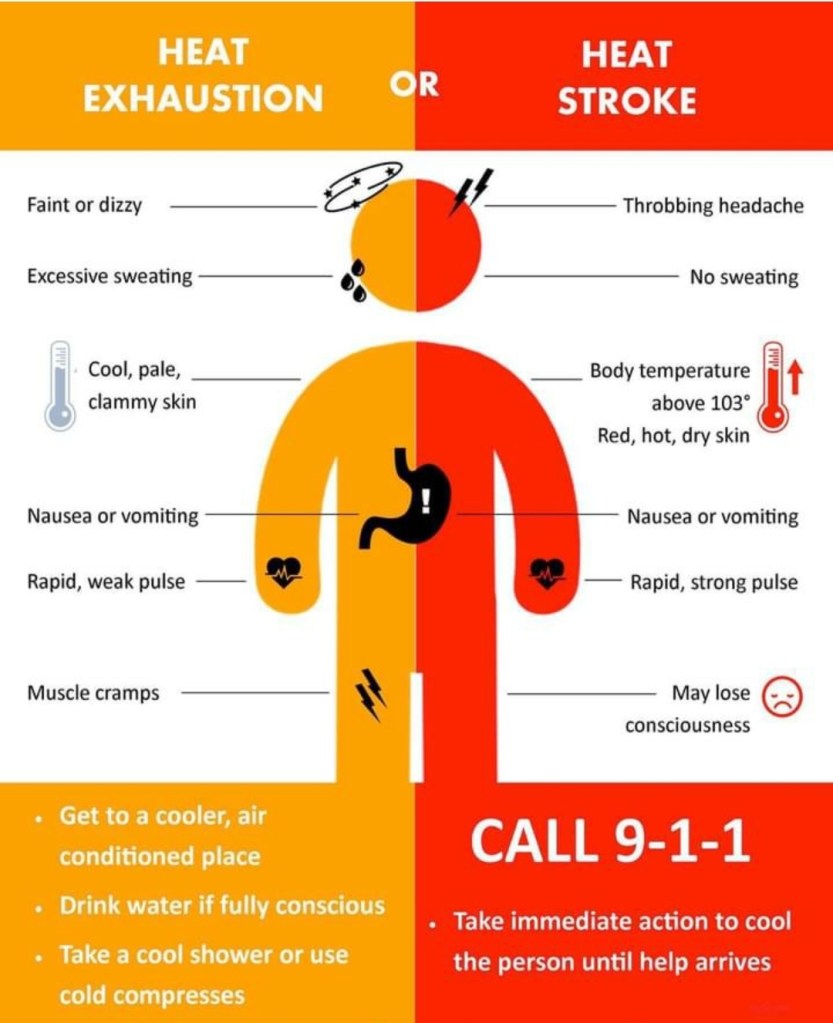
Dehydration is a minor illness that is easily remedied by hydration. However, dehydration can progress to heat exhaustion. The early warning signs of heat exhaustion are nausea, light-headedness, fatigue, muscle cramping and dizziness. It is imperative to recognize the warning signs and act on them as soon as possible.

At the first sign of heat exhaustion, it is important to take the following steps to help get your temperature down and cool your body:

  • Move to cooler place (under the shade of a tree or, if possible, inside)
  • Lower the body’s core temperature. Cold compresses or wet towels under the armpits are very effective in reducing the body’s core temperature. If you do not have access to a cold compress or towel, you can use a neck gaiter or bandana and wet it with water from your water bottle. If you have access to a cool stream, river, or lake that you can dip the neck gaiter/bandana into, even better! Neck gaiters/bandanas are small, lightweight and easy to stuff into a pocket or your waistband.  Like a whistle, I always carry a neck gaiter on long runs. I call it the “MacGyver Approach” to safety.
  • Remove tight or extra clothing layers
  • Replace fluids slowly. This is not the time to start chugging water or sports drink since heat exhaustion can impair your body’s ability to digest properly. Focus first on lowering the body’s core temperature and then replacing fluids slowly.

Heat exhaustion can progress to heat stroke. Unlike heat exhaustion, heat stroke requires immediate medical attention. Someone experiencing heat stroke may have a headache, confusion, no sweating, rapid heart rate, nausea or vomiting and may lose consciousness. When the body is hot to the touch and not sweating, you should immediately suspect heat stroke.  When heat stroke is suspected, it is vital to take the following steps:

  • Call 911 immediately
  • Move the person to a cooler place
  • Use cold compresses or other options to lower the body’s temperature
  • Do not give them fluids as their body will not be able to absorb them and you will only increase the probability of vomiting.

Finally, do not let all this talk about heat-related illness paralyze you. Knowing the enemy is the best way to overcome it! Now that you know the signs to look for, you can take appropriate precautions to ensure you do not experience them. Remember to hydrate early and often. And if you feel that you are may be suffering from heat exhaustion, take the appropriate steps to keep yourself safe. And do not forget to have fun out there!

Stress Relief during COVID

The blog post below was featured this week on the Team USA website sponsored by USA Triathlon. These are the people who regularly compete in Ironman triathlons. These triathlons are grueling tests of endurance over 2.4 miles of open water swimming, 112 miles of cycling, and then a full marathon, 26.2 miles.  And just to be clear, that’s all in ONE race for a total of 140.6 miles in 17 hours or less! And what are these athletes talking about these days? The benefits of WALKING. Don’t let anyone tell you that walking is “cheating”. Walking is a sport with HUGE physiological and psychological benefits as described below. Even hardcore athletes can benefit from 10 minutes of walking a day, so you can too!


PHYSIOLOGICAL AND PSYCHOLOGICAL BENEFITS OF WALKING

By Deanna Pomfret | Aug. 04, 2020

There’s overwhelming evidence that walking produces health benefits in people especially the older population, individuals who are not currently active and those interested in maintaining a healthy weight. Here are some suggestions on how to take these learnings and apply them to a different context, the already active individual.

Your heart is still working whether you are walking, cycling or swimming. Point is, if you can get outside and walk you are training your cardiovascular system. These cardiovascular benefits are not limited only to when you walk. They show up in your daily life and in your other sports.

Take it to nature. Whether it’s the woods or near the water, exposure to this environment has shown reductions in stress and improved self-reported fitness and mental well-being.

A short walk can help you recover faster. Cortisol is a marker of stress. If you are threatened or challenged physically or emotionally your adrenal glands release more cortisol to help you respond to this stimulus. In the past it was essential to survival in the chase for food and to avoid danger. Today we have many stressors, some that can be avoided and others that are necessary for adaptation and growth. Much of our training for sports is a deliberate stressor, one that is necessary for growth in fitness and performance. This combined with so many of life’s other stressors can easily overwhelm us and prevent us from moving forward.

Walking is considered anabolic or stress reducing. Walking can help manage these stress hormones. A walk in the woods has shown decreased cortisol levels in subjects from numerous studies. This is important for athletes who are seeking an opportunity to recover quicker, spend time with loved ones and continue to move their bodies forward.

This is also extremely important for people who struggle with chronic stress or diseases related to adrenal function such as Addison’s disease. Get out and walk, even if it’s 10 minutes a day.  It reduces stress.

Walking has also been shown to improve one’s own body image. Too often we are too hard on ourselves. We focus on what we feel we should be doing rather than what we are doing. Some people may think that a lighter, stronger version of themselves is a better version of themselves. Appreciate where you are now and embrace what your body can do today and build from here. Walking can help you tune into what is possible today and this is what helps you cross the finish line. Believe in yourself just as you are.

When Time Stood Still

This past week, Garmin, a popular platform for tracking fitness activity, was hacked by cyber pirates and their files were held for ransom. For many Garmin users, this seemed like the apocalypse. Our watches stopped mid-workout. Data did not sync to Garmin Connect. Data did not transfer seamlessly to other platforms we use to keep track of our progress. I did not even know how many steps I took each day! HORROR of HORRORS!

I have become so used to Garmin telling me how far I went, at what speed, at what heart rate, how this activity has impacted my training, how my fitness level is progressing, how I am acclimating to heat and altitude conditions and so many other metrics that I literally stopped in my tracks. For almost a week, I was not sure I could get out bed because of the Garmin outage. I turned to Facebook running groups for support and found that almost everyone was feeling the same way I was feeling. It is the Big Brother we have come to know and love guiding us through our day. It seems like a positive kind of technology, not the invasive kind…or so I thought.

How is it possible that being active by walking, running or hiking, which I do at least six times a week and often more, losses its meaning when an app goes down? That’s crazy, right? I reminded myself that I still did the exercise, but knowing that did not seem to help me get my motivation back. I thought back to the days fourteen years ago when I started training using only a heart rate monitor. The data was not hooked up to anything. Cell phones had not even been invented yet. After I finished my activity using my heart rate monitor, I would write down how I felt about the activity in my journal. Remember those paper datebooks with a page for each day of the week? I used those to manually keep track of my progress. I wrote down my metrics (heart rate, distance, time) as well as some notes about my day before, during and after the activity. I wrote about what I ate and how it made me feel. I made notes on things that worked well and things I wanted to do differently in the future.  However, the system seemed cumbersome at the time.  Garmin and other similar tools seemed to solve that problem for me by adding up the data allowing me to analyze metrics over days, weeks, months and even years.  That seemed like a step forward, until this week, when I realized something was missing.  

It turns out that there is something extremely satisfying about tracking your progress, even if it is not in a high-tech fashion. There is value to be gained from actually reflecting on how the workout went: what went well, what did not go as planned, ideas for making it better next time, and seeing how I feel now compared to how I felt last week and last month. And there is more to that than just numbers.  Garmin does give you the option to rate your feelings about a workout with 5 emojis ranging from smiley to frowny. However, I never use that tool. How can you rate a run on a score of 1 to 5? Everything is subjective. The value comes in really thinking about the whole run and how it made you feel during the whole day. During the Garmin outage, I realized that when I am reviewing my data, I do that naturally and automatically. But I do not write it down. And now I realize that is a mistake. When I did not have the data, I did not take time to reflect. And as a result, I lost my motivation.  

I encourage you to take the time to journal after a walk, a hike, a run, or any other workout you do regularly. What did you like? What didn’t you like? Were you in a special place? How did that place make you feel? Would you like to go back there again? What was the weather like? What does it feel like to get outside during the rain, the snow, the wind, the summer heat, or the cool morning breeze?  Taking time to reflect on these thoughts can not only help you develop healthy habits by keeping you motivated, it can be satisfying in and of itself. Journaling allows you to be in the moment and reflect on the experience. And of course, by journaling regularly, you will start to see trends in what makes you happy. And once you know that, you will open up endless possibilities for continuing along the path that makes you happy.

5 Tips for Getting More Active

Well, here we are. We are still sheltering in place. Have you gotten into a routine? What does your “new normal” look like? I hope it includes daily activity.  Getting some exercise is so important now that we are not out running as many errands as we used to. Here are 5 tips to make getting active and staying active easier:

  1. Make a plan. Put going for a walk (or whatever activity you choose) on your calendar. Make it a regular meeting just like you would a work meeting.
  2. Find an accountability buddy. If you can walk with a member of your household or be socially distanced with a friend, awesome! If you do not have that option, you can walk with others virtually via Zoom or by having a good old-fashioned phone call while you walk. Sharing the time with others makes the time go much faster.  If you cannot get outside with someone else or you prefer to walk alone, check in with your accountability buddy before and after your activity so you are accountable to each other for getting up and moving.
  3. Start small. Any activity will do. I enjoy walking because not only is it relaxing, it’s easy! We all do it every day, so I know you can do it. However, if your schedule does not allow you to get outside, how about getting up and stretching for a few minutes a couple of times a day? Whatever you choose to do, start with a small amount of time. Do not try to accelerate your body from zero to 60 miles per hour overnight. Even 10 minutes is worthwhile and should be easy to fit into your schedule. Gradually increase the time or distance as you develop a habit, but give your body time to adapt before taking on any big increases.
  4. If something hurts, get help. The problem may be easily fixable, so do not just give up. Correcting your stride or stretching certain muscles may help.  But also, do not just ignore it and try to keep going either, because that is how people get injured. Being active should be enjoyable. This is not about suffering. If you are suffering, you are doing it wrong! If you do not know where to get help, you can always reach out to me and we can brainstorm together. 
  5. And finally, have a goal. I know a lovely lady is who working toward being able to walk for a whole hour without being tired. I know another wonderful woman whose goal is to be able to hike hills regularly.  And I have a fabulous friend who used to have difficulty walking 2 miles at the time, but after developing a habit of walking every day is now walking 6 miles at the time! And many ladies, including myself,  set daily step goals for themselves. Having a goal gives you something to work toward and makes being active even more fun!

Lean In

Did you know that leaning from your ankles into your walk or run can make it feel easier? Why? Because you are using gravity to help move you forward. Don’t believe me? Give it a try:

Stand with your posture aligned by making sure you head is directly over your shoulders, your shoulders are directly over your hips, and your hips are directly over your ankles. Next, make sure your knees and toes are parallel with each other and pointing forward. Visualize a rod from the top of your head to the bottom of your ankles keeping you straight. Now bend at the ankles. Don’t break at the waist, but rather keep your entire body straight (keep visualizing the rod) and lean forward from your ankles. You will almost immediately fall forward and need to use one of your feet to stop the forward propulsion. That is the work of gravity. When your foot hits the ground, that is the first step…literally, you just took a step!

You can practice this technique against a wall. Stand a few feet from the wall and make sure your body is aligned (visualize the rod again to help you with the alignment). Stretch out your arms and put your hands on the wall as you lean forward from your ankles. Remember to keep your waist and hips aligned—do not break at the waist.  Imagine what a rod would look like leaning against a wall. Your body will form a triangle against the wall. Keep this position when walking and running and you should find that gravity will work in your favor. Gravity will pull your body weight forward putting less strain on your muscles and joints and allowing you to walk and run with less effort!  

Interested in more tips like this? Join my transformative 24-week program, Finding Joy in Motion, starting September 15th. Please let me know if you would like to learn more by contacting me here.

Should you Go Far or Go Fast?

There is no one-size-fits-all strategy for weight loss. However, many people believe that being more active can help you lose weight since burning more calories can help to shed pounds.  If you are walking or running in order to lose weight, how can maximize your calorie burn? Should you focus on distance or on speed?

The Case for DISTANCE:

Long runs and walks can build endurance and improve overall cardiovascular health. The longer your walk or run, the more calories you burn. But how far should you go? By gradually increasing your distance over time, you will help your body gain more endurance and burn more calories. Be sure not to increase your distance more than 10% from week to week in order to reduce the risk of injury. Ramping up too quickly can be damaging to your body.  If you take more than two weeks off (work, family and illness can easily derail your routine), back off on your distance and then build back up slowly while keeping the 10% rule in mind. The older we get, the easier it is to lose fitness gains when we take time off. That is one of the reasons that consistency is so important. But life happens, so we need to anticipate and adjust for it. And remember, long walks should be done at a pace that allows you to talk comfortably while walking on flat ground.

The Case for SPEED:

Speed runs and walks are done faster than the pace at which you feel comfortable talking, but not so fast that you cannot catch your breath. However, in order to speed up your pace, you will likely need to reduce the distance you walk or run. The good news is that the faster you go, the more calories you burn at a given distance.  You may burn as many calories on a faster shorter walk than on a slower longer walk. And fast shorter walks take less time! Obviously, that’s just math.  But when you are pressed for time, it is a good thing to remember.  Going faster does not necessarily mean running when you had been walking. You can increase the speed you walk by increasing your cadence (the number of times your feet hit the ground in a given time period) without having to break into a jog.

So, which should you choose, distance or speed? The answer is BOTH. Why? Because whichever you choose, your body will get used to the routine. And when your body adjusts to the routine and eventually no longer feels challenged by it, you will plateau. The more variety in your workout, the less likely you are to plateau. Changing it up on a regular basis will keep your body working to adapt.  As your body works to adapt, you will see increased fitness gains and you will burn more calories compared to the steady state plateau. This concept applies not only to speed, but also to terrain.  Therefore, should you incorporate hills in your walks and runs?

The Case for HILLS:

Walking and running up hills works the muscles in your legs differently than walking and running on flat ground. And going downhill works your muscles differently than both uphill and flat walks and runs. Variety is the key to progress, of course. The more variety in your terrain, the bigger gains you will see in your endurance and cardiovascular capacity. Hills may seem difficult, but you do not have to start with mountains. How about a small overpass? Or a street with a gradual incline? Or one flight of stairs? Consider giving hills a try.  If you are concerned that hills may be too challenging, try going uphill for 15 seconds, and then turn around and go downhill back to where you started. You can repeat this sequence as many times as you feel comfortable knowing that you are never far from a rest break. You can do this!!!

Streaking

Well, the shelter-in-place seems slowly becoming a new normal. In some ways, I am grateful for the shelter in place because it encouraged me to shift my focus from distance running to speed. Since I did not want to venture far from the house, I started running up and down our cul-de-sac, much to the amusement of my neighbors who prefer to sit on their porches drinking wine. And to make it interesting, I focused on getting faster. My latest 5K time is the closest I’ve been to a sub 30-minute 5K since I started running in 2006. I still have a long way to go, but I feel like I am making progress. As I start increasing distance again in the hope that the Chicago Marathon still takes place at the beginning of October, we will see how that affects my new pace.

Other people have come up with other ways to keep things interested during the shelter-in-place. “Streaking” is the last trend in the running community. Don’t worry! People are still keeping their clothes on–despite the onset of summer and the ever-increasing heat. Streaking involves running every single day—a “running streak”, so to speak. Typical training wisdom has always said that one should not run every day and that the body needs rest. Most people run 3-4 times a week and that is typically considered sufficient even to train for a full marathon. So, what about this streaking trend? Should you run every day?

My view on streaking is that there is “running” and there is “running”. What is the difference between the two, you ask? Just because you are “running” every day, not every day needs to be a  hard “run”. Just like you walk around the supermarket at a different pace when you go in “just to get milk and get outta there!” versus when you do not know exactly what you need and you slowly cruise all the aisles, you can run and you can run. If you choose to be a streaker (pun intended!), be sure to vary your distances and pace. Do not make every day a 10-mile run (or walk) as fast as you can go. Insert some one-mile (or less) days and some casual jogs within your streak. That may even be the healthiest option at all: where you keep moving, but still incorporate rest. This is commonly called “active recovery” and can be even better for you than complete rest, which allows your body to stiffen up due to inactivity. So by all means, streak! Just streak smartly. Happy running!

Compression Socks

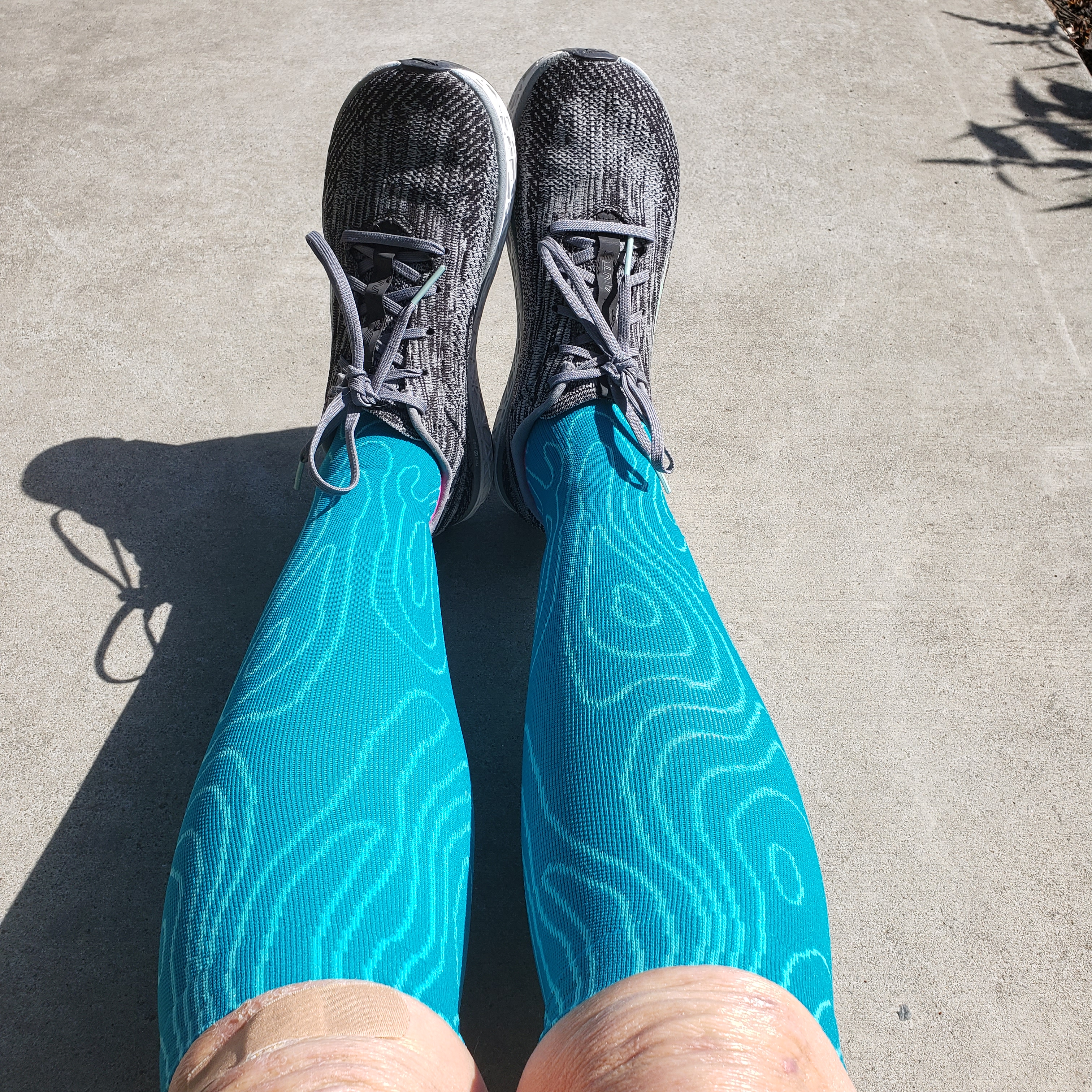
Compression socks can keep your legs from getting tired and achy. They can also ease swelling in your feet and ankles. Some athletes, including runners, basketball players, and triathletes, wear compression socks and sleeves on their legs and arms. The theory is that, during activity, better blood flow will help get oxygen to their muscles, and the support will help prevent tissue damage. Afterward, the increased blood and lymph circulation will help their muscles recover more quickly. As a result, they will not be as sore, and they will not cramp as much.

According to Wed MD, studies show compression socks and sleeves have little to no effect on athletic performance. Nevertheless, some people swear by it. The evidence for faster recovery is better, but according to Web MD, it is still not enough to make a difference for non-competitive athletes. However, I am one of those people who swear by it. Why? Because when I run 26.2 miles with compression socks, my legs feel significantly better than when I run without them. My calves do not get as tight and I feel that I do not “suffer” nearly as much during the run. Is that a function of my training and not a function of the socks themselves? Maybe. But the bottom line is that when I am wearing compression socks, I perceive that I suffer less. And as a result, I can train more. And, therefore, my fitness improves.  The end result is that my performance during the run improves and I recover faster. And I recover even faster when I wear them to sleep after a long run. So, I am a believer.

I used to only wear compression socks for recovery because I was concerned that they would increase my body temperature and make me feel hot during the run. One day I noticed that a friend who is a competitive runner (the kind of person who actually wins races) was wearing them during her races and I asked her about that. It turns out, the socks designed for running breathe really well and you do not feel warmer when wearing them.  Ever since then, I have been a believer in wearing them for all my races and long training runs.

I also wear compression socks when I travel as studies have shown they do prevent blood clots. And again, traveling involves a lot of walking and often long hours on my feet. Why shouldn’t I be comfortable?

The good news about compression socks is they definitely do not hurt your performance. While the jury may be out on how much good they do, they will definitely not inhibit you. So why not give them a try for yourself and make your own decision? Here are some brands you may want to consider:

ProCompression: the basic, reliable, go-to sock that provides excellent graduated compression in a variety of colors. Sign up for their mailing list as they offer discounts all the time. 
www.procompression.com

Zensah: the fun, energetic and whimsical sock. These run tighter in the calf than ProCompression and the compression is less graduated. However, no one currently beats their selection of fun prints and patterns designed to accessorize any outfit! 
https://www.zensah.com/pages/limited-edition

Tiux: I recently tried these and I find them to be very comfortable with excellent compression. Another benefit is they are individually designed for the right and left foot. Not as many color options as ProCompression or whimsical prints as Zensah, but they did give me a discount code worth 30% off for all of you!  

http://tiux.refr.cc/carlaf